
Since 2017, I had already experimented with different solar bikes: upright bike with solar trailer, then recumbent bike with trailer for the 2020 Tour de France and the 2021 Tour of Europe.
In anticipation of the elevations of the Sun Trip Alpes 2022, I wanted to return to the upright bike. The idea was to be able to pedal like a dancer when needed. And to save weight, I abandoned the trailer in favor of a solar roof. My concern was about the wind resistance, which is more important on an upright bike than on a recumbent bike. But I was inspired and reassured by the successful experiences of Daniel Jenni and Sybille Felder on an upright bike, and Peter Helsen on cargo bike.
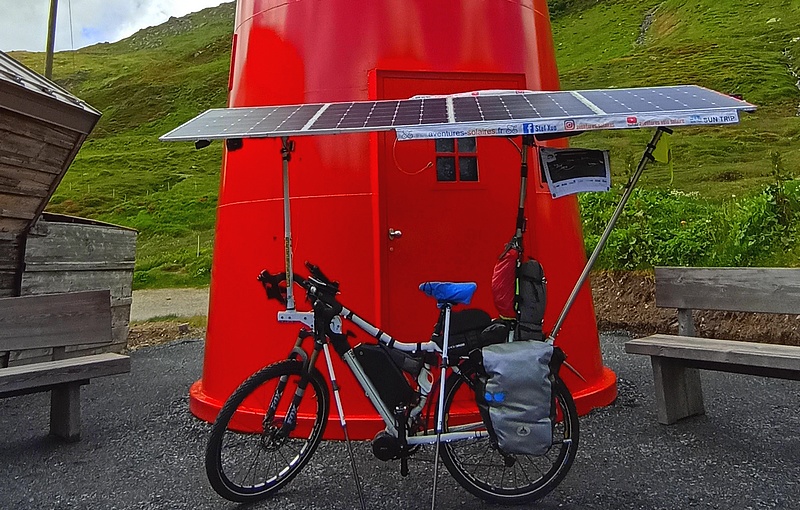
Technical description
The bike
I reused a Matra e-bike, of which I only kept the cycle part. For me, it’s like a gravel bike: its geometry suits well to me, it accepts 28″ or 26″ wheels thanks to its disc brakes. I installed a road handlebar which allows multiple positions, appreciable during long days of travel. The other equipment is:
- FOX RL100 suspension fork replacing the original rigid fork. I wanted to face the holes in the road without difficulty (memorable fall in Hungary, in 2021!);
- Mavic Crossmax wheels, from my mountain bike, to be able to leave the asphalt if necessary;
- Schwalbe Marathon Tour Plus tyres, to avoid punctures;
- TRP Spyre mechanical brakes.
The engine
For this trip through the Alps, I ditched the in-wheel Direct Drive motor that I used in previous years. The reason is the overheating in the long passes which forced me to stop to cool down (experiments in the Pyrenees and the Alps).
I opted for a mid-drive motor Bafang BBS02 , in my opinion more suitable for Alps. I hesitated to add my Direct Drive hub motor which would have allowed regeneration and therefore the recharging of the battery riding dowhill. But as I wanted to lighten the bike, I gave up this option.
I bought two additional accessories, not supplied as standard in the motorization kit:
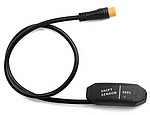
- a shift sensor: this allows the system to cut off power to the motor when using gears. When the level of assistance is high, I consider it essential to limit jerks and preserve the chain.
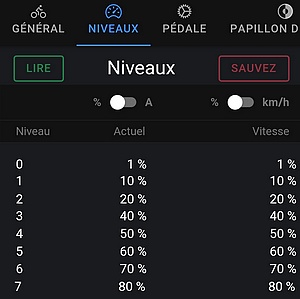
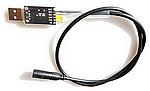
- a USB TTL connection cable; by connecting the Bafang motor controller to a smartphone (via an application like Speed, Bafang Go), it allows you to change the motorization parameters, particularly max power and max speed for each level of assistance… You have to know that the default setting of the assistance levels is very energy-intensive. It’s a good idea to set assistance to a “more reasonable” level for cloudy days. It is also possible to save parameter files, e.g. (1) bright sun / (2) clouds and reinject them according to the weather context / height difference.
Solar equipment
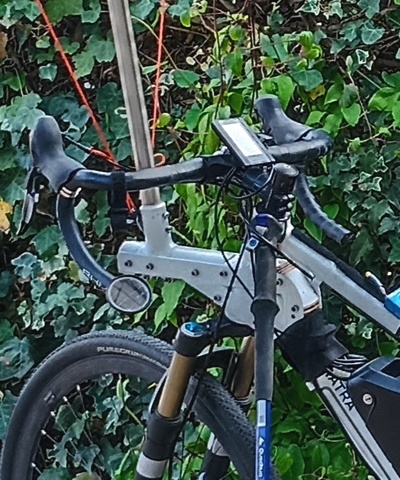
Installing solar panels on an upright bike poses a series of problems to be solved: which anchor points for the roof, what height, what surface of panels, what supporting structure…?
Ultimately, I installed:
- a horizontal support at the front, which extends the frame and is attached to the head tube by steel plates. It supports a vertical tube which is the first point of support for the roof.
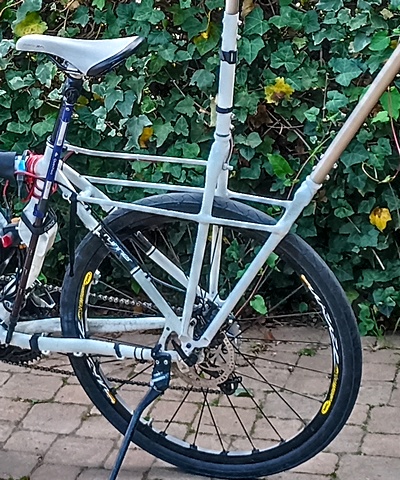
- a support at the rear, fixed to the frame, at the level of the holes provided for the luggage rack. It was made from an old bicycle frame (I kept the rear triangle). It supports a vertical tube, the roof’s second main support point, and an oblique tube which limits the front/rear oscillations of the roof.
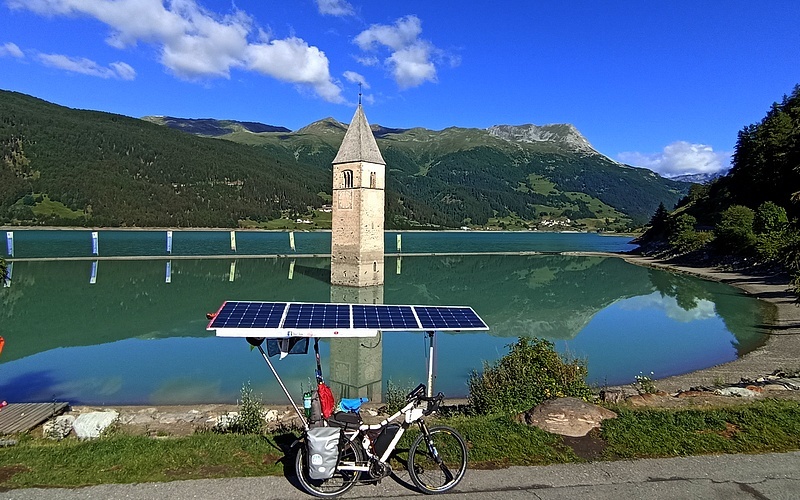
I started testing it with 3 solar panels, i.e. an area of 1.5 m². As the behavior was very satisfactory, I lengthened the roof reaching 2 m² of exposed surface, i.e. a power of 400 Wp. Total size: 2.70m x 80cm.
The panels can be tilted, while driving or stationary. A string allows you to adjust and maintain the desired inclination. I hesitated to use silent blocks as a fixing point for the roof, but ultimately, I recycled old handlebar stems and it worked perfectly.
Experience report
I was generally satisfied with this bike, it corresponded rather well to my expectations, for a cost of 2000€ all included.
Overall weight
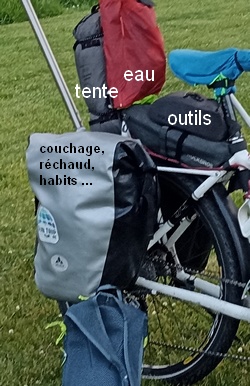
I managed to contain the empty weight of the vehicle to 42 kg (bike, motorization, solarization) which seems important to me in the mountains (but the lightest bike of the Sun Trip Alpes was Émile’s one with 30 kg only!). For a bike in travel condition, I had to add my luggage and saddlebags (11 kg), a repair kit with tools and spare parts (2.5 kg), not to mention water and daily food. Which ultimately gives a vehicle which weight approaches 60 kg.
Motorization
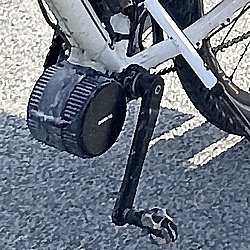
I was able to see the efficiency of the bottom bracket motor compared to the wheel motor I had previously. In the Stelvio Pass in 2022, I made the ascent without difficulty and in one go, whereas in 2021, I had to stop to let the hub motor cool down. I checked it at each pass. The weight gain in 2022 (-20kg) has certainly also contributed to this success.
In addition, I really appreciated the possibility of reprogramming the levels of assistance according to needs (weather/altitude). And if the weather had been worse, it would have been even more decisive for saving energy.
Electrical system
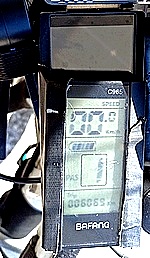
Surprise: the display and control console some day turned off permanently, for no particular reason. Fortunately, I was prepared to this eventuality by carrying a spare screen in my first aid kit, and in 5 minutes, it was fixed. This confirms that some electrical components are fragile and carrying a spare can save you from trouble abroad.
Another surprise: three days after a torrential rain, my electric assistance failed. The cause was moisture that had entered the buid-in motor controller. Once dried, everything went back to normal, but at the moment, it was a source of stress. Today I redid the seal by adding silicone sealant.
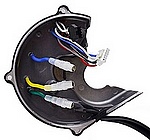
To the traveler who goes to the end of the world, I would even advise to carry a spare controller (440g), it is a source of serenity. For those who do not wish to overload themselves, the alternative would be to give it to a friend who can ship it at any time.
Regeneration
I didn’t suffer from the lack of regeneration on the descents. I consider that this assessment is linked to the very favorable weather conditions during this Sun Trip Alps. I am aware that if the sun had been rare, I would have regretted not being able to produce energy riding dowhill.
Supporting structure
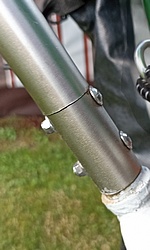
The first tests carried out around my house allowed me to quickly realize that the pivot tubes used were too thin (thickness: 0.6mm). Ultimately, I have choosen 1.2mm thick steel tubes. Furthermore, I realized that the ruptures had always occurred from a hole drilled for the passage of a screw. The repeated bending of the tubes tested these points of fragility. As a result, in my next constructions, I will try to avoid this method of fixing.
In a travel situation, after 5000 km, I conclude that my construction behaved well overall, the flexibility of the structure allowing it to absorb shocks.
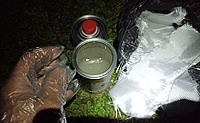
I recommend carrying around some glass mat and 2-component epoxy resin. This allows any kind of repair for a reasonable weight (300g). By carrying out the repair at the end of the day, at the campsite, in the morning you find the resin which has hardened the fiberglass wrapped around the broken part. In the 2021 Europe tour, it saved my trip several times! In 2022, I was able to help Kilian repair a key piece of his solar structure.
Roof behavior
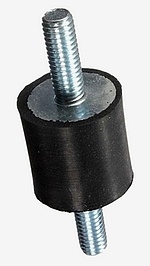
For 3 weeks, I rode through the Alps without worrying about the wind. But on the last day, we crossed the Rhone valley with sideways gusts which brought a lot of stress to the ride. In the future, I would like to test a construction incorporating silent blocks to dampen gusts. Indeed, Sybille Felder did not have the same feeling on this day, and its silent blocks gave great flexibility to its roof which absorbed the onslaught of the wind well .
Solar area
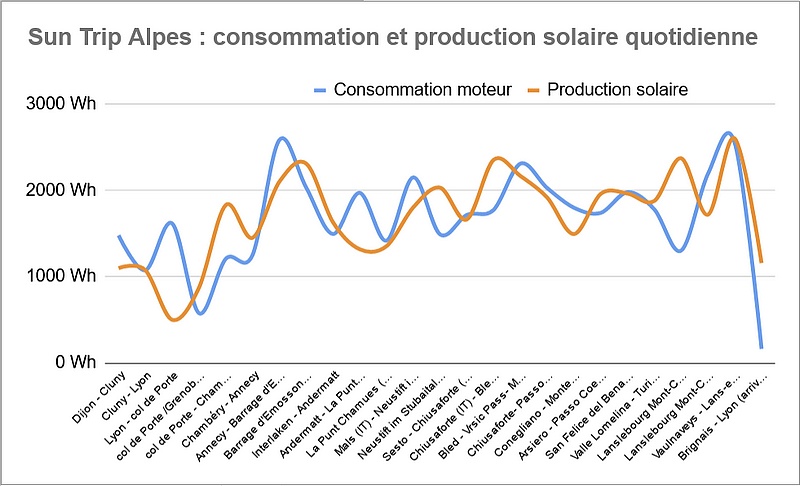
On average, my 2 m² of panels produced 1650 Wh per day. They produced more power than the 2.5 m² I had on my trip around Europe in 2021 (average 1550 Wh/day). This performance is probably linked to several factors:
– a cooler temperature in the mountains allowing better performance of the panels,
– better sunshine,
– all the panels as roof (in 2021, the panels on roof could shade the panels on the trailer).
Vehicle cost
| Amenities | Price |
| Matra e-bike, Fox F100 RL fork, Mavic wheels (used equipment) | € 380 |
| Bafang BBS02 crank motor kit – 48V – 750W | € 360 |
| Accessories: gear shift sensor, programming cable, spare console | € 60 |
| 52 V 1080Wh battery | € 480 |
| Solar panel supporting structure : recycled material or purchased from a participatory bike repair workshop La Rustine or Emmaüs | € 55 |
| Linksolar solar panel 5×6=30 cells, 100 Wp – 4 panels | € 660 |
| Total | €1995 |
Usage Review from 2022 to 2025
This bike no longer exists since a fall on a bumpy dirt road in the Moldovan countryside at the end of May 2025. There, I had to discard 80% of its structural elements to keep only the bare essentials: I created a sort of luggage rack that carries all the stacked panels.


This bike, which I designed and built in the spring of 2022, still accompanied me for more than 13,000 km, from the preparatory training for the Sun Trip, the Sun Trip Alps 2022, the Sun Trip Alps 2023, and finally the European Odyssey 2025 to Moldova.
Its geometry was excellent, even if the many kilometers ultimately tired the structure. This has happened to me on other bikes; the stresses to which manufactured parts are subjected can lead to breakage after more than 10,000 km of good and loyal service (e.g., Bob Yak’s drawbar broke in Bulgaria in 2021).
This build has demonstrated many qualities:
- Its relative lightness (42 kg bike, motor panels, battery) for 400Wp of exposed panels and 1080 Wh of battery,
- Its better compactness than my previous bikes with a trailer (length 2.68 m, width 79 cm),
- No shadow of the cyclist on the panels (compared to trailers),
- Ability to ride on dirt roads, even if it was slower than bikes with suspended trailers, such as the Aevon,
- Compactness once disassembled (I managed to fit it into a Peugeot 207),
- Main weak point: tricky handling in very windy conditions, when gusts exceed 65 km/h. Wind gusts can change the trajectory and surprise the cyclist. This is a common weakness of most bikes with solar roofs. On this trip, during a late afternoon in Hungary, I was accidentally pulled into a ditch. I had to continue across the fields to escape the busy road. Luckily, it didn’t pin me to the ground, as it did in 2020 in the Rhône Valley (gusts of 85 km/h). Dänu Jennihas found a solution that reduces this defect and relies on the use of silent blocks that add flexibility to the roof, helping to absorb the irregularities of wind gusts.
After removing the roof and installing the solar panels stacked on the luggage rack, I managed to take a bus from Moldova to Lyon, then a regional train from Lyon to Dijon.
 Démontage du vélo pour être accepté dans le bus international

